
🎉Preliminary Selected for
2025 5th IYAC Global Youth Art Competition🎉
Officially invited to exhibit at Detour Gallery in New York.

Equal Flames, Unequal Rescue:
Harmonious Ignorance
This work is based on wildfires and reveals how the natural disaster is perceived based on one’s environment. Using powdered branches and leaves collected from a real fire site, I contrasted a child abandoned in front of a burnt shack with a wealthy family receiving prioritized care. This illustrates the sharp inequality within the society that is hidden and ignored by restrictive and forced harmony. This work calls for greater awareness and a more just approach to establish a harmonious society.
Exploring Materials
I explored a range of materials, from traditional ones like acrylics and pastels to natural elements like charcoal, soil, and burnt wood. I was searching for something that could carry both emotion and meaning

Charcoal and Conte
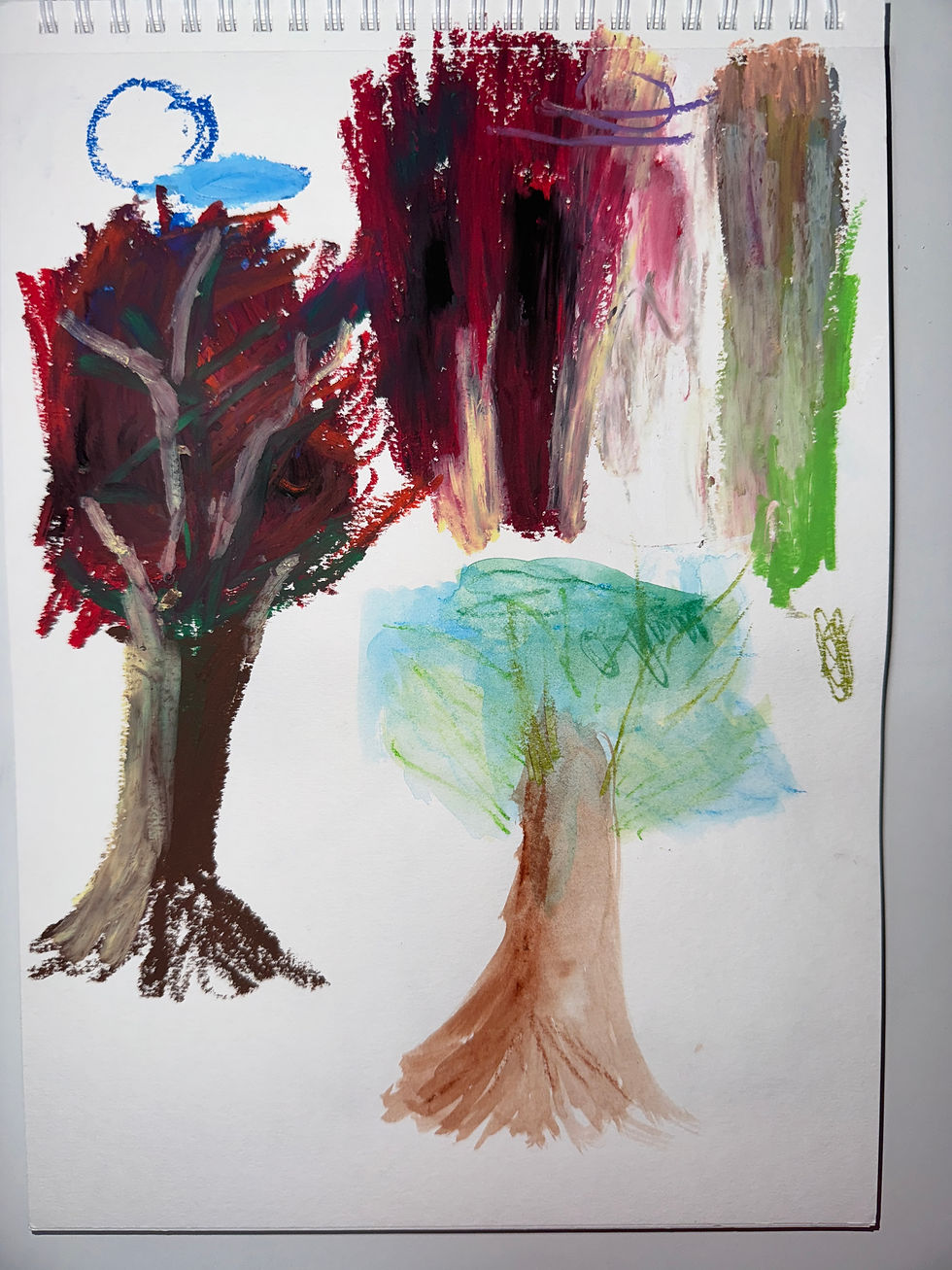
Oil Pastel & Water Color

Pencil & Charcoal

Oil Pastel
How It All Started
It all began with a question: What can I use art for to convey authenticity?
When I learned of the devastating forest fire in Korea, I visited the site and not only did I see the aftermath of the forest, the charred trees, but I also saw the impact on people. That's when I knew I could turn this artistic endeavor into a message. I took home some of the charred sticks and trees and, once pulverized, decided this would be my material. Then, the work came to life through.
Equal Flames, Unequal Rescue: Harmonious Ignorance
During the ideation phase, I sketched different concepts exploring destruction, inequality, and recovery. I wanted to show how the same natural disaster can affect people in vastly different ways. The idea of contrasting a wealthy home and a poor container house, divided by a fallen tree, became the foundation for the final piece.
Ideation Phase


Retrieving Materials
What was an authentic addition to my process was a field trip. I visited the mountainous part of Korea, where a recent forest fire had occurred. I hiked through the aftermath and collected natural materials with a history still attached: charred leaves, crispy branches, powdery ash, and chunks of charred tree bark. Each had its texture and history, generating new parts of the project from the remains.
Burnt Leaves
fragile and charred, often crumbling into ash
Charred Branches
blackened wood, partially preserved but brittle

Ash and Soot
fine powdery residue left on the ground or debris
Scorched Bark
thick, cracked surfaces with deep burn patterns